Moving Construction Materials to Site in Riyadh: A Contractor's Truck Guide
By Mohamed Ahmed, Co-founder, Markaby
9 min read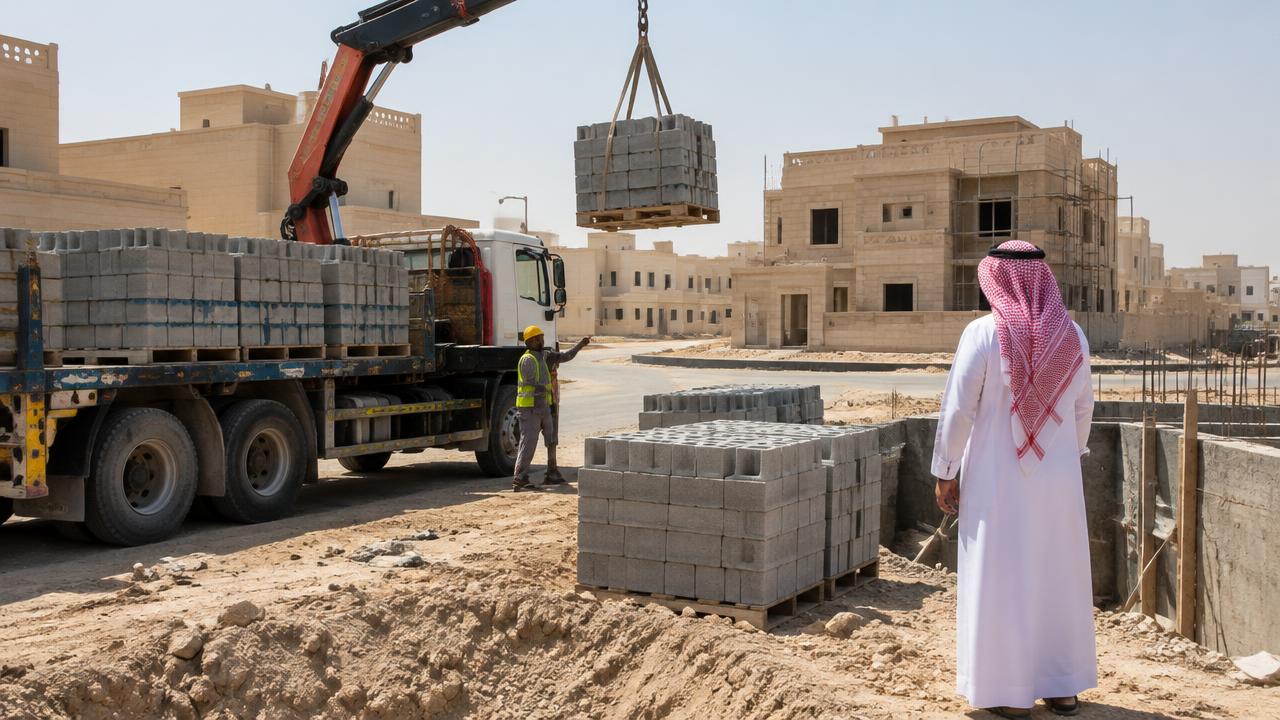
Short answer: for construction sites in Riyadh, match the truck to the material and loading method. Use a Dyna for small top-ups (up to ~3 t), a lorry for bagged cement, tiles and sanitary ware (up to ~10 t), a flatbed for rebar, blocks, pipes and equipment (up to ~24 t), and trailers for heavy haulage. Plan trips around site hours and Riyadh's truck city-entry rules. Use a provider that can schedule several trips a day and send one monthly invoice to your project accounts.
Reading time: 9 minutes
Contents
- Riyadh's construction boom and why logistics is a bottleneck
- Material-by-material truck guide
- Planning a site delivery day
- Rules every Riyadh contractor should know
- On-demand, scheduled or contract: which booking model?
- Paperwork: CR, VAT invoices and proof of delivery
- Where Markaby fits on a construction project
- FAQ
1. Riyadh's construction boom and why logistics is a bottleneck
Saudi construction has grown fast. The number of establishments working in contracting reached 386,498 in Q1 2026, up from 207,608 in 2023, an 86% increase in three years (Al Watan). Riyadh, with its giga-projects, residential expansion and commercial build-out, carries a large share of that activity.
More contractors means more trucks competing for the same roads, site gates and time windows. On most projects, the cost of a late delivery isn't the transport fee. It's a crew standing idle, a concrete pour delayed, or a crane hired by the hour waiting for steel that hasn't arrived.
Getting materials to site on time comes down to three things:
- The right vehicle for each material.
- A realistic schedule that respects site hours and city-entry rules.
- A provider that answers the phone when plans change at 6am.
2. Material-by-material truck guide
| Material | Typical loading | Recommended vehicle | Notes |
|---|---|---|---|
| Small top-ups (fixings, tools, a few bags) | By hand | Van or Dyna | Fast, fits site gates easily |
| Bagged cement, plaster, adhesives | Forklift or by hand | Lorry (up to 10 t) | Protect from rain and dust; check weight, not just volume |
| Tiles, porcelain, marble slabs | Forklift on pallets | Lorry or flatbed | Strap carefully; slabs need A-frames |
| Sanitary ware and kitchen units | By hand or pallet | Dyna or lorry | Fragile, often bulky but light |
| Concrete blocks | Forklift on pallets | Flatbed (up to 24 t) | Heavy; one flatbed can replace several smaller trips |
| Steel rebar | Crane or forklift | Flatbed | Long lengths need deck space and proper strapping |
| Pipes and conduits | Crane or forklift | Flatbed | Watch overhang and length rules |
| Generators, compressors, small machinery | Crane or forklift | Flatbed | Secure with chains; check height |
| Scaffolding and formwork | By hand or forklift | Lorry or flatbed | Bulky; plan the return trip |
| Very large equipment, project cargo | Crane | Trailer | May need special permits and route planning |
For a deeper guide to vehicle classes, read Dyna vs Lorry vs Flatbed vs Trailer.
Weight first, then shape
Construction materials are heavy for their size. A flatbed rated at 24 tons may look half-empty when it's at its legal limit with blocks or rebar. Saudi Arabia enforces truck weight limits by axle, and the Roads General Authority stresses distributing legal weight across axles (Riyadh Daily). Overloading to "save a trip" risks fines at weigh stations and damage to the truck and road.
3. Planning a site delivery day
A good delivery plan fits on one page. Here's a template that works for most Riyadh sites.
Step 1: confirm the site window
When can trucks enter the site, and when does the crane or forklift operator work? Many sites prefer early-morning deliveries before heat and traffic peak.
Step 2: check city-entry timing for heavy trucks
Large trucks entering Riyadh during restricted hours need an electronic appointment through the Naql portal (see section 4). If your supplier's yard is outside the city, or the truck comes from another region, build this into the schedule.
Step 3: sequence the trips
Deliver what the crew needs first. On a slab day, that's rebar and formwork before blocks. If you need several trips, ask for multi-trip scheduling, so the same provider runs the sequence instead of you booking each trip separately.
Step 4: assign an on-site receiver
Someone with authority must check quantities, sign off and photograph the load on arrival. Disputes about "short" deliveries are far easier to settle with timestamped photos.
Step 5: plan the return
Empty pallets, unused materials and scaffolding all need to come back. Book the return trip with the delivery so the truck doesn't leave empty and come back tomorrow.
4. Rules every Riyadh contractor should know
4.1 Truck city-entry appointments
The Transport General Authority runs a programme to regulate truck entry into major cities through electronic appointments at scheduled times, launched in partnership with the General Directorate of Traffic and the Ports Authority (Al Watan). Riyadh's phase came into force in January 2023 (Saudi Gazette). Licensed carriers book through the "City Entry" service on the Naql portal (Saudi Gazette). Restricted hours and Ramadan timings change, so check the portal or with your carrier before planning a heavy delivery into central Riyadh. Full guide: Truck Entry Rules for Riyadh.
4.2 Use licensed national carriers
The TGA limits domestic goods transport to licensed national carriers and warns companies against contracting foreign-plated trucks for domestic transport (Ajel). Contractors are named directly in that warning, so check who's actually carrying your materials.
4.3 Heavy cargo regulation
Trucks with a total weight above 3,500 kg fall under the heavy cargo transport regulation (Qanoniah). Nearly all construction deliveries do.
4.4 Exceptional and oversized loads
If a single item exceeds legal weights or dimensions and can't be divided, it's an exceptional load under Saudi freight regulation (Qanoniah) and needs special arrangements. The TGA has also introduced online permits for some configurations, such as double-trailer trucks outside cities (Ajel English).
5. On-demand, scheduled or contract: which booking model?
| Model | Best for | Watch out for |
|---|---|---|
| On-demand (book today) | Emergency top-ups, unplanned shortfalls | Availability of big trucks at short notice |
| Scheduled (book days ahead, fixed times) | Planned pours, phased deliveries | Changes need early notice |
| Contract / monthly | Long phases with steady daily volume | Minimum commitments; agree service levels in writing |
Many contractors end up with a mix: a monthly arrangement for the steady flow, and on-demand bookings for surprises. Our guide Monthly Truck Contract vs On-Demand Booking walks through the trade-offs.
6. Paperwork: CR, VAT invoices and proof of delivery
Construction accounts teams deal with hundreds of supplier invoices. Make transport easy for them:
- Check the provider's Commercial Registration. CR details can be checked through the Ministry of Commerce and the Saudi Business Center (Ministry of Commerce).
- Insist on compliant e-invoices. ZATCA's e-invoicing Phase 2 is rolling out in waves to VAT-registered businesses (ZATCA). Non-compliant transport invoices create input-VAT headaches.
- Prefer one monthly invoice per project with trip-level detail (date, vehicle, route, site), rather than dozens of receipts.
- Keep proof of delivery: signed delivery notes plus photos, linked to each trip.
7. Where Markaby fits on a construction project
Markaby is a Saudi goods-transport app, live in Riyadh, operated by ClickGate Online Company (CR 7053870908, VAT 314685449900003).
What we offer contractors:
- Dyna (3 t), lorry (10 t), flatbed (24 t) and trailers in one account
- Scheduled pickups and multiple trips per day
- Live tracking of every truck heading to your sites
- One monthly invoice for business accounts
- Verified drivers and vehicles, checked before joining the network
Where we're honest about limits: we're live in Riyadh today, with other cities coming soon. For mega-project fleets with dedicated on-site dump trucks for months at a time, a specialist equipment-rental company may suit that specific need better. We're strongest at moving materials and equipment to sites on schedule.
Tell us your site location, materials and trips per week: request a construction quote or WhatsApp +966 54 037 4939.
FAQ
What truck do I need to deliver rebar to a site in Riyadh? Usually a flatbed, because rebar is long and heavy and is loaded by crane or forklift. Flatbeds carry up to about 24 tons.
Can I book several construction deliveries on the same day? Yes. Ask for multi-trip scheduling. With Markaby, business accounts can schedule multiple trips and track all of them live.
Do construction trucks need appointments to enter Riyadh? Heavy trucks entering Riyadh during restricted hours need an electronic appointment through the TGA's Naql portal "City Entry" service. Check current hours before planning.
Is it legal to hire any truck for building materials? Domestic goods transport must use licensed national carriers. The TGA specifically warns companies, including contractors, not to contract foreign-plated trucks for domestic moves.
Can I get one invoice for all my project deliveries? With Markaby business accounts, yes: one monthly invoice with trip-level detail.
Keep reading
- Markaby for construction
- Flatbed truck booking in Riyadh
- Truck entry rules for Riyadh
- Dyna vs lorry vs flatbed vs trailer
References (Saudi sources)
- Al Watan: contracting establishments reach 386,498 in Q1 2026: https://www.alwatan.com.sa/article/1184495
- Riyadh Daily: RGA truck dimensions and weight limits: https://www.alriyadhdaily.com/article/fa536a505df545beae23576c6f8bea25
- Al Watan: TGA programme regulating truck entry to cities: https://www.alwatan.com.sa/ampArticle/1086530
- Saudi Gazette: Riyadh truck entry by prior appointment (Jan 2023): https://saudigazette.com.sa/article/628972
- Saudi Gazette: City Entry service on the Naql portal: https://saudigazette.com.sa/article/631166
- Ajel: TGA, licensed national carriers only: https://ajel.sa/local/m15oos68lk
- Qanoniah: Heavy Cargo Transport Regulation: https://qanoniah.com/en/File/OZl513E6qoW1Jy67e0G2BdaxD-Implementing-Regulation-for-Heavy-Cargo-Transport-Activities-for-Commercial-and-Non-Commercial-Purposes
- Qanoniah: Freight Transport Regulation (exceptional loads): https://qanoniah.com/en/File/2BJmxzW4K1LG53OnvwQd5pNgk-Regulation-Governing-the-Activity-of-Freight-Transport,-Freight-Forwarding-Agents,-and-Truck-Rental-on-Land-Roads
- Ajel English: TGA permits for double-trailer trucks: https://english.ajel.sa/saudi-arabia/4iwm2wgxq
- Ministry of Commerce: CR inquiry: https://mc.gov.sa/ar/mediacenter/News/Pages/23-04-24-01.aspx
- ZATCA: e-invoicing roll-out phases: https://zatca.gov.sa/en/E-Invoicing/Introduction/Pages/Roll-out-phases.aspx